Now, first things first I feel like the most important thing to mention is the fact that different isopods need different types of care— This will not encompass all isopods, but it’s definitely a good place to start.
So, you want to care for isopods— the first thing you should probably do is decide what species you want to start with and start getting familiar with the scientific name of different species. Choosing a species can be overwhelming when there’s so many different types and colour morphs, so one thing I like to offer is for people to ask themselves:
Do you want them to curl into a complete ball? Or is a C shape fine?
if you want your isopods to roll into a complete ball like the stereotypical ‘rolly Polly’ you’re going to want to go with an Armadillidium species. If you’d prefer or are okay with a C shape, you’d likely be getting a Porcellio species.
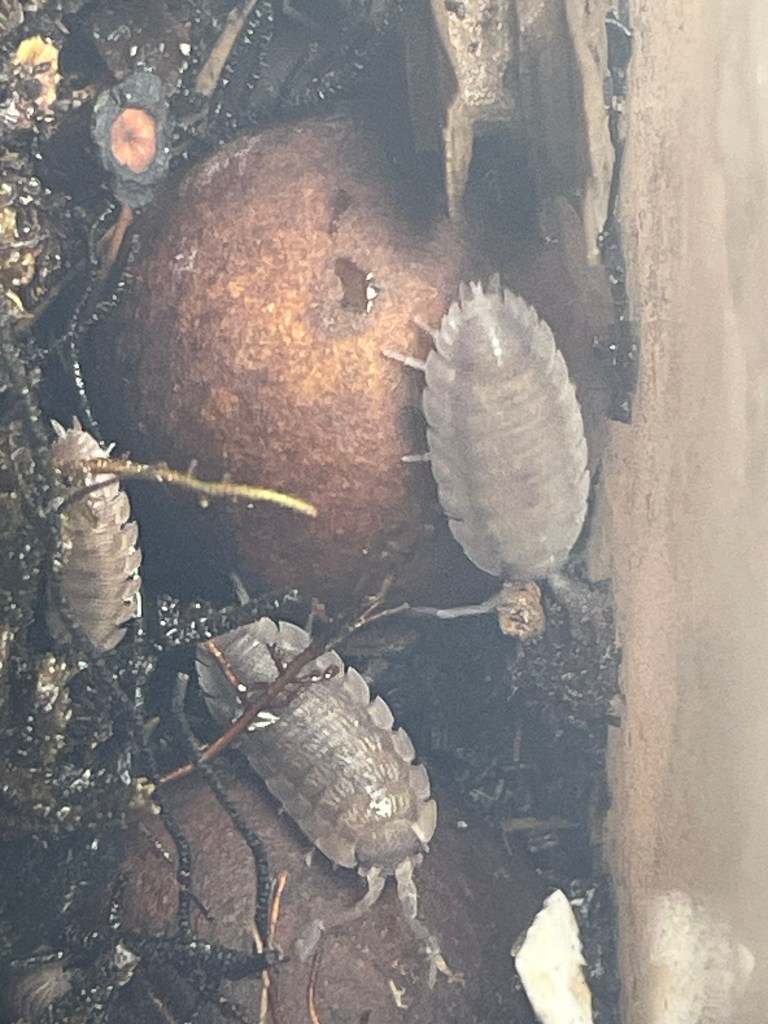
the cheapest, and most readily available isopod to keep as pets tend to be Porcellio Scabers. These are a grey “wood louse” that are known for being more “aggressive” than other species. Of course, this doesn’t mean they can hurt you! Aggressive in this case, means they will eat their young if not given enough calcium, and they are one of the only larger isopod species that can cohab with Trichorhina tomentosa (dwarf white isopods) due to the fact they will occasionally eat them, which will help prevent the Dwarf Whites from overtaking them. They are relatively active isopods, and prefer a moist environment but are quite hearty, so they will not die if you forget to mist them for a day or two. They procreate quickly, and have some interesting colour morphs. Generally speaking- they are the ideal and standard “starter” isopod for anybody who wants to get into the hobby. Getting just 5 to 10 adult isopods and given a few weeks in good conditions will begin a strong colony that will last for ages.
image is some of my Porcellio Scaber isopods from my personal colony.
The other types of isopods you’ve likely heard of for keeping as pets are as follows:
Armadillidium
- Armadillidium cubaris sp (Rubber Ducky isopods)
- Armadillidium maculatum (Zebra Isopods)
- Armadillidum klugii (Clown Isopods)
- Armadillidium gestroi (Yellow spotted isopods)
Porcellio
- Porcellio laevis (Dairy cow Isopods)
- Porcellio expansus (Dragon Isopod)
- Porcellio hoffmanseggi (Titan Isopods)
- Porcellio magnificus (Magnificent isopods)
Generally speaking, for any isopod you’re going to want some type of tank or terrerium (5gals is good to start), some substrate and moss, some spring tails, some wood, and the occasional food.
When you get your tank- you’ll want to fill it around quarter to half full of substrate. This can be a number of things, cocoa fiber is common- but some people use potting soil, or a mix of sand and dirt depending on the isopod. Peat moss or Sphagnum moss is also commonly scattered throughout the terrarium as well as chunks of charcoal, and wood chips. Leaf litter and any rocks, nuts, and other decorations can go ontop of the substrate. If you want to add any large pieces of wood, sticks, or logs, make sure to boil them for a few minutes to kill any potential contaminates, parasites, or fungus living inside of it.
Once your terrarium is built, its a good idea to look into adding spring tails. These are small, almost microscopic insects that’ll help clean up anything the isopods don’t. You don’t need to worry about them much, and they dont typically need any additional care aside from what you give your isopods. You do not need to feed your isopods daily, but its near impossible to “over feed” them either (unless you dont want thousands of babies). Isopods cannot get “fat” and will not eat unless hungry (which they frequently are). Any “excess” food will be eaten and used to produce more offspring and enhance the colony. Generally, tossing in vegetable or fruit scraps when they turn up in your kitchen will do just fine.
You will need to mist the enclosure daily, or sometimes multiple times daily. You want the substrate to often be damp but not soaking wet. Don’t waste your money on a terrarium humidity gauge, they only measure the humidity in the air while isopods depend on humidity in the soil. Most soil humidity gauges are also far too large to fit in a standard enclosure, this is something you’ll simply learn to do by eye and feel- thankfully, most isopods can handle fluctuations in the humidity.
When you first set up your enclosure and add your isopods and springtails, you may notice due to the misting, moss, and other natural organic materials that it starts to grow mold. Do not fret! Mold is actually quite common, and is unlikely to hurt your new pets. The isopods will not eat the mold, but they will eat whatever the mold grows on. Generally speaking, it can take a few cycles of babies being born before you notice the mold disappearing. If it concerns you, then you can do your best to clean it up or apply vinegar to the area to reduce it. The average gestation for isopods is 40-50 days, so it can take a few months to start getting the results you expect.
Hopefully this has been helpful in teaching you the general gist of isopod keeping- For more information, its a good idea to pick a specific species and search facebook groups, forums, and reddit for information regarding that species. You can, of course., always ask me as well and I can see about doing another blog post on specific species. Thank you for reading!~
 Learn about the bugs in your backyard
Leave a comment